

If you run a business anywhere in the Dallas Fort Worth Metroplex whether that’s a retail strip on Belt Line Road in Addison, a medical suite inside a Frisco professional building, or a restaurant in Deep Ellum there is one marketing investment that pays you back every single day without requiring a monthly subscription fee, a boosted post, or a copywriter on retainer. That investment is your signage.
But here’s the real question business owners wrestle with: Do you put your dollars into outdoor signs that pull traffic off the street, or indoor signs that convert the customers who are already inside? And in a market as competitive and regulation-conscious as Dallas, does that decision look different than it would somewhere else in the country?
The honest answer is yes and the goal of this guide is to walk you through exactly what separates the two categories, what each type accomplishes for your specific business model, what Dallas-specific permit rules and 2026 signage trends you cannot afford to ignore, and how to build a signage strategy that treats indoor and outdoor as a coordinated system rather than an either-or choice. By the time you finish reading, you will have a clear, actionable picture.
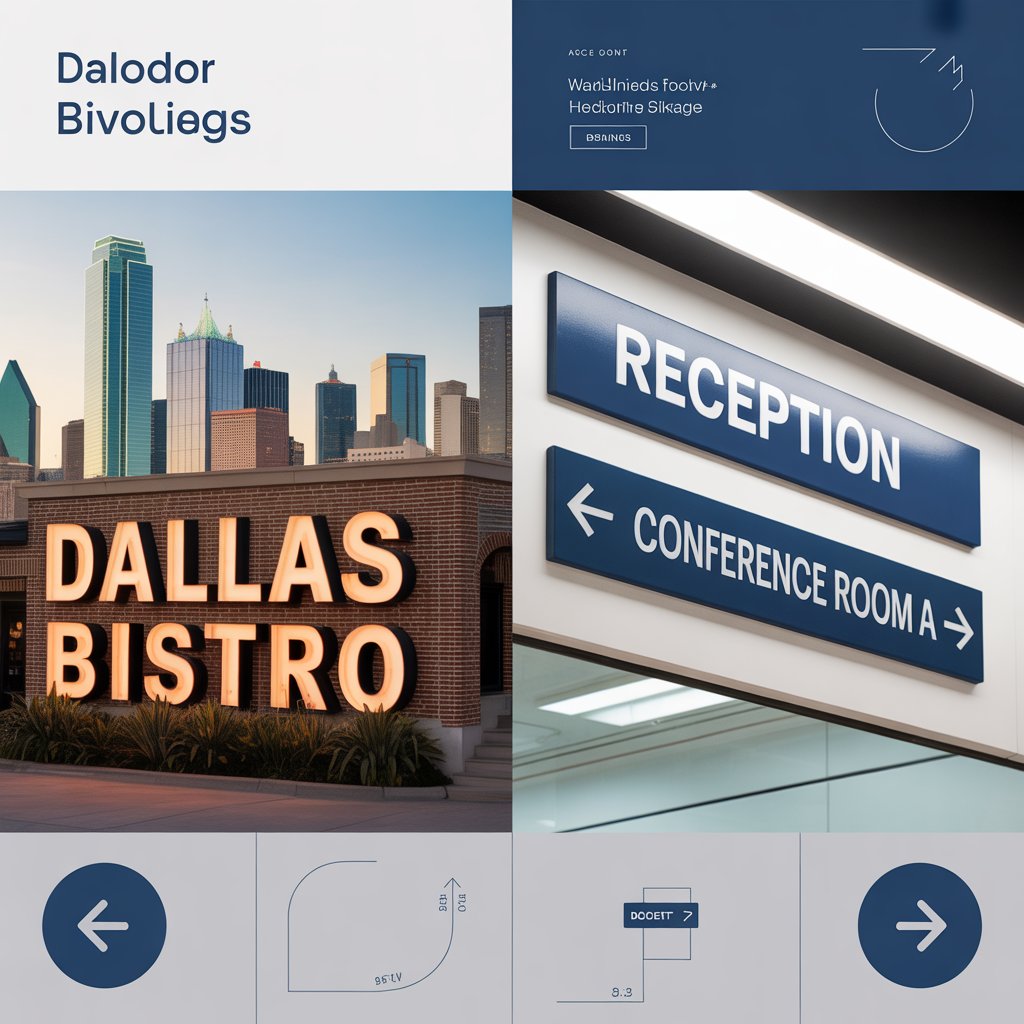
1. What We Mean by Outdoor Signs and Why They Earn Their Keep
Outdoor signs are everything a potential customer sees before they set foot through your door. That includes your main building-mounted sign, any monument or pylon sign near your property entrance, window lettering visible from the street, LED message boards, blade signs, canopy graphics, and even temporary banners or feather flags used during a promotion or grand opening.
The core job of every outdoor sign is simple: interrupt the attention of someone who did not wake up that morning thinking about your business, and give them a reason to stop. In a city like Dallas, where the driving culture is dominant and most commercial corridors run at 35–50 mph, you typically have three to five seconds to land your message. That is not a lot of time which is why material choice, letter height, contrast, and lighting all matter far more than most business owners initially realize.
The Types of Outdoor Signs Dallas Businesses Use Most
Channel letter signs are the workhorse of Dallas storefronts. These individually fabricated dimensional letters are mounted directly to a building facade and can be front-lit, back-lit (halo), dual-lit, or open-face neon. Because they are three-dimensional and self-illuminated, they read well in both daylight and after dark a significant advantage in a city where dinner traffic, late-night retail, and 24-hour services are all common business models.
Monument signs serve a completely different purpose. Rather than identifying the building itself, a monument sign marks the entrance to a property from the road. You see these at apartment complexes, medical campuses, shopping centers, and office parks throughout Plano, Richardson, Irving, and the Uptown corridor. They establish presence, reinforce brand permanence, and help customers locate a property that may be set back from the street.
LED electronic message centers (EMCs) are the fastest-growing category in the Dallas market right now, particularly for businesses in high-traffic locations where the ability to update messaging in real time creates a meaningful competitive edge. Quick-service restaurants, auto dealerships, gas stations, churches, and urgent care centers have been the early adopters, but the technology is spreading rapidly into retail and hospitality.
| DALLAS CONTEXT | As of 2026, Dallas enforces some of the most detailed sign regulations in Texas under Chapter 51A, Article VII. The city’s 8-Word Rule limits most facade-mounted signs to eight words of text taller than four inches. Expressway-adjacent signs along I-75 and I-35E face area caps and strict setback requirements. Working with a locally experienced sign company is not optional it is the difference between a permitted sign and a costly removal order. |
What Outdoor Signs Actually Deliver for Your Business
The most frequently cited statistic in the sign industry comes from research suggesting that a well-placed storefront sign is seen by the same consumer population repeatedly over time, functioning like a billboard you only pay for once. In high-density Dallas corridors, think Greenville Avenue, Lower Greenville, Mockingbird Lane, or the retail clusters in McKinney and Frisco; your exterior sign is working during every hour of the day your business is open and every hour it is closed.
Foot traffic generation is the metric most directly tied to outdoor signage. Businesses that add or upgrade an exterior sign consistently report an increase in walk-in inquiries, particularly from customers who were unaware of the business despite having driven past it multiple times. This is especially relevant in DFW, where residents frequently discover new businesses while commuting rather than through deliberate search.
Brand visibility is the longer-horizon benefit. Your outdoor sign teaches the surrounding community what your business looks like, what colors represent it, and what category it operates in all without you spending a dollar on advertising. Over months and years, this passive brand-building is genuinely difficult to replace with any other marketing channel.
2. What Indoor Signs Actually Do and Why They Are Rarely Optional
Indoor signage is everything your customer encounters once they cross your threshold. This is a broader category than most business owners initially appreciate. It includes your lobby sign, directional wayfinding panels, menu boards, promotional display graphics, office room identification signs, ADA-compliant tactile signs, wall murals, window frosting, point-of-purchase (POP) displays, and any branded dimensional element that lives inside your space.
The psychological function of indoor signage is different from outdoor. Where outdoor signs attract, indoor signs guide, reassure, sell, and retain. Research in retail environments consistently shows that customers who feel oriented and guided inside a space spend more time there and customers who spend more time in a retail or hospitality environment make more purchase decisions. Indoor signs are not decoration. They are a functional revenue tool.
The Indoor Sign Categories Dallas Businesses Rely On
Lobby and reception signs are the first thing a visitor sees after walking through your door. A well-executed lobby sign whether it is an acrylic backlit panel, dimensional metal letters with standoffs, an illuminated logo, or a sleek brushed aluminum plaque communicates credibility before a single conversation takes place. In professional service industries like law, accounting, healthcare, and consulting, this first impression frequently determines whether a prospective client decides to move forward.
Wayfinding and directional signs solve a practical problem that businesses often underestimate until they see what poor wayfinding actually costs them: confused customers who leave, customers who interrupt staff repeatedly for directions, and a general sense of disorganization that erodes brand perception. In multi-tenant Dallas office buildings, medical campuses, shopping centers, and large restaurants, an intelligently designed wayfinding system is as essential as the seating layout.
ADA-compliant signage is not optional in any commercial space open to the public it is a federal legal requirement under the Americans with Disabilities Act. Restroom identification signs, elevator directories, and room markers must meet specific standards for tactile lettering, Braille, color contrast, mounting height, and finish. Non-compliance creates genuine legal exposure, and it is an area where working with a knowledgeable local sign provider is particularly valuable.
Point-of-purchase and promotional interior signs are where indoor signage connects most directly to revenue. Counter cards, table tents, window clings, shelf talkers, and banner stands placed near your checkout area or around high-margin products consistently lift average transaction values. For restaurants specifically, menu boards whether static or digital have a measurable impact on order composition and upsell rates.
| EXPERIENCED INSIGHT | The indoor signs that age best are the ones built from the brand up not chosen from a catalog. When your lobby sign uses the same typeface as your business card, your wayfinding arrows carry your brand color, and your ADA signs share the same finish palette as your lobby, customers experience your space as a designed whole rather than a collection of functional objects. That cohesion signals professionalism. |
3. Side-by-Side: Outdoor vs. Indoor Signs at a Glance
The table below summarizes the practical differences between outdoor and indoor signs across the factors that matter most to Dallas business owners making a signage investment decision.
| Factor | Outdoor Signs | Indoor Signs |
| Primary Goal | Attract & acquire new customers | Guide, engage & retain customers |
| Audience | Passersby, drivers, foot traffic | Existing visitors, customers, staff |
| Visibility Range | Feet to hundreds of feet | Within the premises |
| Material Needs | UV-resistant, weatherproof, durable | Aesthetic, brand-aligned, varied finishes |
| Popular Types in Dallas | Channel letters, monument, LED EMC | Lobby signs, ADA signs, wayfinding, neon |
| Dallas Regulation Factor | High – permits, Chapter 51A rules | Low mostly internal ADA compliance |
| Lifespan | 5–10+ years | 3–7 years (depends on material) |
| Best ROI Scenario | High-traffic corridors (I-35E, I-75, Belt Line Rd) | Medical offices, retail showrooms, restaurants |
4. 2026 Signage Trends Reshaping the Dallas Fort Worth Market
The signage industry does not stand still, and the Dallas market in particular is experiencing a confluence of factors rapid commercial development, evolving city permit standards, and a technologically sophisticated business community that is accelerating several important shifts. Understanding where the market is heading helps you make a signage investment that will still feel current three to five years from now.
LED and Digital Integration Is Moving Downstream
Electronic message centers and LED-integrated channel letters were once primarily the domain of large franchises and national retailers. In 2026, the technology has become accessible enough that independent restaurants in Bishop Arts, boutique retailers in the West Village, and professional service firms along the Tollway corridor are incorporating dynamic lighting and digital message panels into their signage programs. The global digital signage market is projected to grow from roughly $29 billion in 2024 to nearly $46 billion by 2030, and the DFW commercial corridor is among the most active adoption regions in the American Southwest.
Dallas Sign Permit Complexity Is Increasing
The City of Dallas has continued to refine and enforce its Special Provision Sign Districts (SPSD) and the broader Chapter 51A regulatory framework. The 8-Word Rule which limits combined sign text taller than four inches to eight words on most Dallas commercial facades catches many business owners off guard, particularly those accustomed to doing business in suburban markets with looser standards. Expressway-adjacent signage along I-75 and I-35E faces specific setback requirements and square footage caps that require careful planning before fabrication begins. Working with a sign company that has current, direct experience navigating Dallas permitting is not a convenience it is essential risk management.
Biophilic and Experiential Interior Design Is Driving Indoor Sign Innovation
Across Dallas’s dining, hospitality, and coworking sectors, the interior design trend toward natural materials, warmer lighting, and experiential environments has created strong demand for indoor signage that goes well beyond functional identification. Custom neon signs, hand-lettered wall murals, illuminated dimensional logos, and textured acrylic panels are increasingly being commissioned as intentional design elements rather than afterthoughts. Businesses in design-forward Dallas neighborhoods the Design District, East Dallas, the Bishop Arts District, and Deep Ellum are leading this trend, but it is spreading rapidly into suburban retail and restaurant environments as well.
QR Code Integration Is Bridging Physical and Digital
One of the most practical signage innovations gaining traction across Dallas retail, restaurant, and service businesses is the integration of QR codes directly into physical signage both indoor and outdoor. Table signs, window decals, lobby panels, and even monument signs now routinely include QR codes that connect the physical customer experience to digital menus, review platforms, loyalty programs, and appointment booking systems. This is particularly relevant in the post-pandemic DFW market, where contactless interaction preferences have remained elevated even as pandemic restrictions ended.
ADA Compliance Enforcement Is Tightening
Legal counsel specializing in ADA access cases consistently report an uptick in demand-letter activity targeting Dallas businesses with non-compliant interior signage. The requirements are specific, technically demanding, and frequently misunderstood by business owners and the penalties for non-compliance go well beyond a corrective notice. Any business undergoing a renovation, relocation, or new lease in the Dallas market should treat ADA signage compliance as a non-negotiable line item, not an optional upgrade.
5. Which Type of Sign Does Your Business Actually Need?
The most useful framework for answering this question is not indoor-or-outdoor it is stage-of-customer-journey. Outdoor signs work at the discovery and awareness stage. Indoor signs work at the engagement, conversion, and loyalty stage. The businesses that get the most return from their signage investment are the ones that have thought through both stages and allocated their budget accordingly.
Start with Outdoor If Any of These Apply to You
- You are a new business or recently relocated, and the surrounding community does not yet know you exist.
- You operate in a high-traffic Dallas corridor where your target customer drives or walks past your location daily.
- Your business depends on impulse or discovery traffic restaurants, retail, service businesses, urgent care, automotive, beauty.
- You are in a competitive retail cluster where neighboring businesses have strong exterior signage and you do not.
- Your current sign is outdated, damaged, poorly lit, or not readable from the street.
Prioritize Indoor Signs If Any of These Apply to You
- You are a professional service business medical, legal, financial, consulting where the client experience inside your space directly impacts trust and referral rates.
- You operate in a multi-tenant building where wayfinding to your specific suite or office is genuinely challenging.
- You have an existing customer base that visits regularly, and your goal is to increase average transaction value or promote specific services.
- You are legally obligated to provide ADA-compliant signage and have not yet audited your space for compliance.
- Your interior space has undergone recent renovation and your signage has not kept pace with the new aesthetic.
The Case for Both Which Is Usually the Right Answer
For most established Dallas businesses with a physical retail or service location, the strongest signage strategy is an integrated one. Your outdoor sign creates the expectation. Your indoor experience either confirms or undermines it. A customer who is attracted by a professional, well-lit exterior sign and then walks into a space with dated, inconsistent interior signage experiences a cognitive dissonance that while they may not consciously name it erodes their confidence in your brand. The inverse is equally true: a beautifully designed interior means nothing if no one can find you from the street.
The businesses in Dallas with the strongest signage programs from the flagship retailers in NorthPark Center to the independent medical practices in Uptown to the restaurant groups in Deep Ellum treat their signage as a unified visual identity system that happens to be split between exterior and interior environments. Every element serves a defined role, every material choice supports the brand, and every investment is tied to a measurable business outcome.
| DALLAS-SPECIFIC RECOMMENDATION | If your business is located in a high-traffic DFW corridor (Lower Greenville, Uptown, Knox-Henderson, the Preston Road corridor, or any major arterial in Plano, Frisco, or McKinney), a channel letter exterior sign with proper illumination should be your first priority. If you are in a professional office park or medical complex, a lobby sign and compliant ADA wayfinding package should be your first priority. When in doubt, consult a local sign professional who can assess your specific location, zoning district, and competitive environment. |
For small businesses with limited initial budgets, the highest-return outdoor sign options in Dallas are illuminated channel letters (for storefront visibility after dark), monument signs (for businesses set back from the road), and high-quality dimensional lettering with a painted raceway. Avoid the temptation to cut costs on illumination a sign that goes dark after 6 PM loses a significant portion of its working hours in a city where evening retail and dining traffic is substantial. If budget is genuinely constrained, a well-executed, properly permitted vinyl letter set on a storefront window is a legitimate first step that can be upgraded later.
Yes virtually all permanent outdoor signs in the City of Dallas require a permit issued through the Development Services Department. The permit application requires construction drawings, a site plan showing sign placement relative to the property line, specifications for electrical connections on illuminated signs, and documentation of compliance with your specific zoning district’s rules under Chapter 51A, Article VII. The timeline for permit approval varies by project complexity and current application volume, but businesses should plan for four to eight weeks minimum. Working with a sign company that regularly navigates Dallas permitting will significantly reduce errors and re-submissions.
Indoor lobby signs in Dallas range widely based on material, size, and complexity. A standard acrylic panel lobby sign with dimensional lettering and stand-offs typically runs between $800 and $2,500 installed. Illuminated acrylic backlit signs or dimensional metal letters with a premium finish range from $2,000 to $6,000 or more depending on size and the complexity of your logo. For medical practices and professional offices where the lobby sign is a primary client-facing brand element, investing in the mid-to-upper range of this spectrum is consistently justified by the credibility it communicates.
Front-lit channel letters illuminate forward the face of the letter glows, making the lettering itself the light source. These are visible from greater distances and work well in bright commercial corridors. Back-lit or halo-lit channel letters illuminate the wall behind the letters rather than the face, creating a soft halo effect that is particularly striking at night and gives a premium, architectural appearance. Halo letters work best against a light-colored or contrasting building facade and are popular with professional service businesses, upscale restaurants, and boutique retailers in Dallas markets like Knox-Henderson and the Design District. Dual-lit letters offer both effects simultaneously
Yes. Under the Americans with Disabilities Act, any commercial space open to the public must meet specific interior signage requirements. This includes tactile lettering and Grade 2 Braille on room identification signs (restrooms, exits, stairwells, permanent spaces), specific mounting heights (centerline at 60 inches from the floor), minimum color contrast ratios, non-glare finishes, and character sizing rules. Non-compliance creates genuine legal exposure — ADA demand letters targeting businesses with non-compliant interior signage have increased in the Dallas market. An audit of your existing interior signs by a qualified local sign company is a reasonable first step
Dallas presents specific durability challenges for outdoor signs: intense UV exposure, summer temperatures that regularly exceed 100°F, hailstorms, and periodic ice events in winter. Quality aluminum and acrylic channel letters with good powder coating and UV-resistant faces typically last eight to twelve years before needing major refacing or replacement. LED modules in illuminated signs have a rated lifespan of 50,000 to 100,000 hours under good conditions, but heat stress in Dallas summers can shorten that window. Annual inspection by a sign technician checking electrical connections, face integrity, LED module function, and mounting hardware is the standard maintenance recommendation for illuminated exterior signs in the DFW climate.
Dallas restaurant operators in 2026 are getting the most mileage from three indoor sign categories: custom neon signs (which function simultaneously as functional lighting, social media backdrops, and brand anchors), digital menu boards (which allow real-time updates for specials, pricing changes, and seasonal menus without reprint costs), and dimensional wall installations that serve as both wayfinding and experiential design elements. The most Instagram-visible Dallas restaurants particularly in Deep Ellum, Bishop Arts, and Uptown consistently use their interior signage as a deliberate social media strategy, treating each sign as a shareable visual asset.
This is highly location-dependent and governed by local zoning. In strictly residential zones within Dallas proper, commercial exterior signage is generally prohibited or severely restricted to very small, non-illuminated identification signs. If your home-based business serves clients who visit your location, you should consult both the City of Dallas Development Services Department and a local sign company before installing any exterior signage. Home-based businesses that operate as registered businesses in commercially-zoned spaces (shared offices, coworking spaces, studio suites) may have access to building directories and interior-only signage options.
For a new DFW location, the sequencing that delivers the best return is: (1) an illuminated exterior sign as your first priority to establish street-level visibility before or at your opening date, (2) a lobby or reception sign that sets the brand tone for every visitor who walks in, (3) ADA-compliant interior signs to meet legal requirements, and (4) promotional interior signs (window graphics, banner stands, table tents) to support your opening-period marketing. Trying to do everything simultaneously on a constrained budget typically results in mediocre execution across all categories. Doing the exterior sign and lobby sign well, then building out the interior program over the first six to twelve months, is the approach most experienced sign consultants recommend.
Final Thoughts: Build a Sign Strategy, Not Just a Sign
There is no universal answer to the outdoor-versus-indoor question because no two businesses occupy the same competitive environment, serve the same customer, or face the same location constraints. What is universal is the principle that signage decisions made with a clear business goal whether that is building street-level awareness on a busy Dallas arterial or elevating the credibility of a professional service practice in a Class A office building consistently outperform signage decisions made purely on aesthetic preference or initial cost.
Dallas is a market that rewards visibility and professionalism in equal measure. The businesses that get both right whose exterior signs pull traffic from the street and whose interior signs convert that traffic into customers and advocates are the ones that build lasting local brand equity. That equity is real, it compounds over time, and it begins with the decision to take your signage seriously.
If you are ready to evaluate your current signage or plan a new installation, the next step is a conversation with a sign professional who understands your specific neighborhood, your permit environment, and your brand. That conversation costs nothing. The sign you choose afterward will work for you every day for years.